
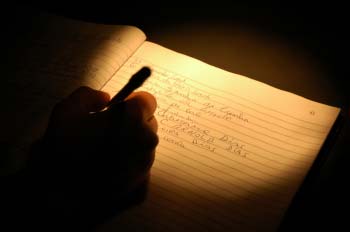
Fiction writing tips.
This post was contributed by Kelly Kilpatrick, who writes on the subject of distance learning universities.
Writing fiction, whether short or long, can be a very trying experience indeed. So many writers of fiction have different processes for achieving their writing goals that it’s hard to sift through what works and what doesn’t.
Writing is a process that requires skill, determination, adaptability, and plenty of time. Here are some suggestions for improving your fiction writing skills, gleaned from trial and error over time.
1. Start With a Seed
Some great fiction books are simply a product of asking the question, “What if…?” Starting a new work of fiction requires just a small seed to get you going. Beginning without too much baggage can really help get the ball rolling.
2. Let the Story Tell Itself
Think of yourself as a medium, or a vehicle, for a story that wants to be told. You may have some idea about where things are going, but don’t create too many constraints for yourself. The story will unfold if you are ready to work hard on keeping up with what it has to say.
3. Use Realistic Characters and Dialogue
This is accomplished through many different approaches. As a writer, you must learn to hone your powers of observation and watch people and how they interact. Research can come in a variety of forms, from reading other authors to watching movies. Keen observation skills and personal experience will help guide you through this aspect of fiction writing.
4. Write What You Know
This is a well-known mantra for fiction writers, yet many fail to adhere to this simple principle of fiction writing. When you write about things you know and experiences you’ve had, the writing is easier to read and comes across as more authentic.
5. Close the Door
When you’re ready to get down to business, find a place where you can go to tune the rest of the world out. If you are planning on writing a long work of fiction, you will essentially be “living in the story.” Be prepared to shut yourself in as you work on bringing your tale to life.
6. Keep Pushing Forward
Don’t get caught up in the past; keep writing each day without taking time to go back and reread. The time for reading what you have written will come, and that’s when you can fix any inconsistencies. Keep writing and worry about the minute details during the revision process. Dedicating specific amounts of time regularly will help you to get the project finished sooner rather than later.
7. Put it Away When You’re Finished
When you feel your story has come to a close, put it away. Get it out of your sight and try your best not to revisit the work while the story is fresh in your mind. Putting some distance between writing and editing will do you and your story some good.
8. Start a New Project
Get started right away on something new to increase the distance between you and your previous work. This will help you to come back with a new perspective and keep your productivity level high in the process.
9. Return to Your Finished Product
After some time has passed, pull out your manuscript and read the piece with fresh eyes. Chances are you will find ways to improve upon and revise the story to make it flow more smoothly.
10. Revise and Edit
Cuts will have to be made. The revision process can be time consuming, but it will help when you’re ready to share your work with another reader for their opinion. Make sure you polish your work as much as possible before giving it to others for their opinions. Eliminating clutter and typos will help you get honest feedback without trivial details getting in the way.
If you have any fiction writing tips to share, feel free to post them in the comments.
Totally agree with #2. I’ve tried outlines and plotting – doesn’t work for me. As long as I can see the ending, I just write.
I think #4 is good, but I’m not convinced it’s the only writing we should do. We should keep the foundation within our realm of understanding, but why not go out on a few limbs to keep things interesting? 🙂
[Lori]
I agree with what you said about #4. It’s important to understand what you’re writing about so that’s why people generally say ‘stick to what you know’ but in my experience, if you research the subject in enough detail it doesn’t matter.
I recently wrote a play set in the First World War. I showed it to the acting group who were going to perfom it and they were shocked to find out that I’ve never taken history and in fact hate the subject! So go out there and read around!
I have great admiration for anyone who writes historical stories (plays, novels, etc.). I had an idea once for a story set in the roaring 20s, but it fizzled out because the research was daunting (and I wanted to get busy writing). Keep up the good work!
@Lori, I love outlines and maybe not plotting – but planning. I’m an idea generator, but the trouble is, I can get stuck in the brainstorming phase and never get out! And I agree with you; it’s not always feasible to write only what we know. That’s where creativity comes in!
I like the idea of starting with a seed. I’ve heard of authors that have written brilliant works of fiction based on a story they read in the newspaper, or based on an exchange between two people that they witnessed at a restaurant, or the words written on a piece of paper that they found lying on the ground.
@Marelisa, I’ve heard the same thing. Isn’t it amazing that writers can take some teeny tiny tidbit and turn it into something captivating? When I was in college, almost every creative writing instructor mentioned newspapers as a source for story ideas, so I guess that’s a big one.
Yep, yep, good list.
“9. Return to Your Finished Product”
We should do this one with our dating options as well! Go out on a few dates. Go away for a while. Come back in a month and see if you still like the person.
Just like some story ideas seem great at the time, you might see later that you were in a temporary state of insanity. Every now and then, there is a keeper, but not all are keepers. *wink*
@screenwritingforhollywood, that’s true – not all are keepers. Not sure I’d use the return to finished products for dating, although now that I think about it, that could be good fodder for creative writing. Hmm.
Thanks for the great tips. I write primarily non-fiction, and find it hard to make the jump into fiction so I appreciate all the help I can get. It’s also nice to know that sites like Mary Patrick Kavanaugh’s community exist so that I have a place to bury my rejected book when the time comes.
@Ruth, yes, making that jump can be difficult, but it certainly can be done. I wish you the best of luck, and thanks for sharing the link to the rejected book graveyard — that’s an interesting site for sure!
I normally don’t like blogs with writing tips, but yours is different. It’s unpretentious and your approach is refreshing. I know you didn’t write this particular article, but I’ve read quite a lot.
I have quite a few projects, but two main ones I work on the most. I have a horror novel (though not really true horror). I’ve rewritten most of it several times, though it’s not finished, but 3/4 done.
I’m writing a book on philosophy with a lot on helping young people make wise choices, stay away from drugs, gangs and have usable coping skills. This may take another few years.
I have several others, like a compilation of short stories, much longer versions than on my blog. I avoid publishing really long stories on my blog because people don’t read them, and anything you want published should never be on a blog first. I like to be careful
But yeah, I write on each of them when in the mood, switch aroung. I read several books at the same time too. I think writers must read a lot. You’re probably like me, you watch any show, you study the script and all the dynamics involved. Writers watch TV & movies unlike people who don’t write.
When I get closer to being done, I may seek out your services as I know I’ll need help. I feel better about dealing with a real person like you than one of the hundreds of self publishing sites people use. I know one guy who has written 13 books, all published by himself and he sells through his site and Amazon. I seriously doubt he ever gains success. He’s been doing it for 20 years. His work is pretty good, but he is aiming too low I think.
Sorry for the long winded screed Melissa! You will get many, many more from me…your new fan! Have a great day 🙂
You’ve got my number! I do watch movies and TV shows with an analytical mind — always asking questions, like are the characters believable? Is the plot resonating? Reading is crucial for writers. In fact, other than the actual writing, I think reading is one of the best things we can do to be better writers. If you do require my services, just contact me. I’ll be here. And always feel free to leave long-winded comments. Nothing wrong with that!
Fiction or non-fiction,after studying the characters one realizes that they need the human touch.I usually let the story tell itself,only then the characters speak for themselves and you can keep pushing forward
The “human touch” is a perfect way to describe what makes characters real. Even aliens, robots, computers, and animals have excelled as characters because of the human element of their personalities.
This is nearly the same outline of tips from Stephen King’s book: “On Writing”. It is highly recommended for those looking for elaboration on these great points.
I too recommend “On Writing.” It is one of my favorite writing resources, though I hadn’t read it before I accepted this guest post. Hmm…
Write anything that comes to your mind, as long as it flows with the story and sounds good. Also, never stop believing in yourself.
Great tips, Arianna, especially that second one!
I recently began searching the web to find tips on writing a story. I have never liked writing and in school writing and reading did not come easy. I suppose a mental issue.
I have a story I would like to write. It has become an obsession. The story has been bouncing around my head for the past 15 years. I decided I want to do something about it.
I’m very grateful for people willing to share their ideas and talents.
Thanks for sharing your story, Amilcar. A love of writing is not necessary — there are lots of people who write simply because they have a story or idea to share, and writing is merely the means to an end. I wish you the best of luck in telling your story.
Great tips! I think the hardest part of writing is staying motivated to persevere until the end. I’ve certainly found that with myself, anyway.
I found the most irritating thing with writing, however, is when large bursts of writing are included. I’m a huge fan of smaller paragraphs, they’re much more readable.
Yes, big, long paragraphs tend to turn me off too.
I sometimes feel like I have too much to write but the problem is I’ve got lots of schoolwork and also I just don’t know how to start. I wonder if the greatest writers write part time or full time.
It’s probably both. There are full-time and part-time writers. It’s tough to keep up with your writing while you’re in school, but it will be even tougher later when you are holding a full-time job. I think for a lot of writers, the trick is to write a little bit every day. You should be able to find 20-30 minutes in your daily schedule to write. Another trick is to use down time for planning. I develop my characters and plan my plot when I’m driving, showering, cooking, etc. That way, when you sit down for your writing session, you know what needs to be done and can just get it written. Good luck to you!
Novel writers must examine their work,making it funny nd sad.it prompt i nice work
Is it weird that I sometimes lie awake at night and write an entire story in my head? The story sounds much better when I make in in my head, but when I put the story I have made in my head on paper, it just doesn’t have the same mood.
I don’t think it’s weird, but I do it myself.
Once you put the story on paper, let it sit overnight or for a few days. Make some revisions to it, then let it sit again. Most of us find that our attitude toward our work ebbs and flows. A page of prose that seemed brilliant on Monday is garbage on Wednesday but not half bad by Friday–and that’s without any revisions. Stick with it.