
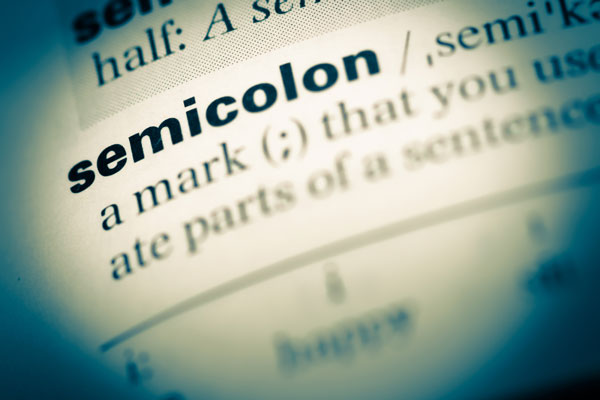
How to use a semicolon.
Lots of people aren’t sure how to use a semicolon.
The semicolon might be the most misunderstood punctuation mark in the English language. This dot-comma combination is often used where a period, colon, or even a plain old comma belongs.
Underused and often abused, the semicolon is useful in a number of writing situations. Although proper semicolon use requires a little finesse, this particular punctuation mark is surprisingly easy to understand.
How to Use a Semicolon
Here’s the lowdown on semicolon use, along with examples showing semicolons in action:
The semicolon establishes a close connection between two sentences or independent clauses. Example: There’s nothing like the gentle drum of water hitting the window pane; I love the sound of rain.
A semicolon can replace conjunctions and or but. Example: It’s too stormy outside for me; the rain is good for the trees.
Semicolons indicate a stronger separation than a comma but weaker than a period. Example: Jane went to the store; she stopped for gas on the way home.
A semicolon is often used in lists to separate items when some of the items in listed subsets require commas. Example: I have lived in several different cities: San Francisco, California; Haiku, Hawaii; and Santa Barbara, California.
The semicolon is always followed by a lowercase letter with proper nouns being the only exception (proper nouns are always capitalized). Example: I love music; however, I haven’t played my guitar in several years.
Semicolons can be used to separate two clauses or sentences that are saying the same thing in different ways. Example: The sun is out, and the sky is blue; it’s a beautiful day.
As with other punctuation marks that denote the end of a clause or sentence, there is no space between the semicolon and the word preceding it; there should be a single space after the semicolon.
How Do You Use a Semicolon?
In many cases, semicolon use is appropriate or grammatically correct, but when a period will do the trick, go with two separate sentences. In other words, if you can choose between separating clauses with a semicolon or writing two separate sentences (using a period), write two separate sentences. This makes text easier to read.
How often do you use semicolons? Do you think it’s best that this punctuation mark is used sparingly, or should we all aim for increased semicolon use — start a new fad, maybe? Share your thoughts on how to use a semicolon in the comments.

I’m a huge fan of semi-colons; I use them in the technical writing that pays my bills and the fiction writing that keeps me happy. Oh, and clearly, I use them in blog comments too!
I don’t recall when I learnt to use semi-colons, though I remember reading about them in various style manuals and thinking ‘Hmm, so I do do it right then’.
There’s a time and a place for their usage though, and I have a feeling that sometimes I use them a bit too much; for example, between sentences where a period would probably be more appropriate.
I’m curious why everyone is spelling semicolon with a dash (semi-colon). Hmm…
@Sharp Words, I am fond of semicolons too, but I tend to go with a period if I can because I think that’s more natural for readers.
A great site. Your use of many examples is a great means to implant correct semicolon usage in the long term memory of your readers.
Thank you for contributing to web in this way, and for instilling good writing skills within people in our society.
thanks a lot!
ps- haiku, hawaii? where is this? i lived in kailua for 16 years…. are you reffering to the haiku gardens in kaneohe?
We should use semicolons more simply because, being on the home row, they are easy to type.
@Geno: Thank you. It’s been my pleasure. Let’s hope society’s writing skills continue to improve.
@Maria: It’s on Maui, not far from Paia. I have no idea where Kailua is, or the haiku gardens for that matter. I went to Ouahu for ten days after I graduated high school, and then I lived on Maui for a few months several years later. Loved it, but I got island fever and had to return to the mainland.
@Simon: Good point.
Quick Question.
Is the below sentence using the semicolon correctly?
If there is a casue; there is a reaction.
Thanks for your help!
Jesse R.
Jesse,
I don’t think so. The word “cause” is spelled incorrectly. Also, I think the saying goes For every action there’s a reaction.
A comma or semicolon is not necessary because the two halves on either side of the semicolon in your example don’t stand alone, and therefore are not independent clauses. Plus, as a rule of thumb, punctuation should not be inserted unless it enhances or clarifies meaning. In this case, it does neither.
Thanks, Jesse.
That is embarrassing. I just recall from a course (technical communications) that using a semicolon after an “if” statement is okay. I won’t quit my day job. Thanks for you help Melissa.
Hi Jesse. Nothing to be embarrassed about! There are some situations in which it’s okay to use a semicolon but not necessary and then it’s really up to the writer to make a judgment call. That’s just one of the many reasons why writing can be so tricky.
I would have to argue that the comma (as opposed to the semicolon) is probably the most misused punctuation mark in English. As far as I know, semicolons are merely used to connect two independent clauses. Commas are used for a wide variety of purposes. I don’t know… I just seem to see so many misplaced commas, but I rarely see semicolons being used at all.
@Eugene: In most cases in which a semicolon would be appropriate, I’ll go with two full separate sentences; i.e. forgo the semicolon and use a period instead. Yes, the comma is grossly misused all over the place. Don’t get me started on serial commas…
I am learning English together with my children. We are trying to figure out how to use semicolon in proper sentences, when to use and when we should not.
If anyone can share with us, thank you so much !
Hi Catherine. This article explains how to use semicolons. Did you read it? Do you have any specific questions?
im soooo stuck on using them i just done get it
HELPPPP
You might pick up a grammar guide. Grammar Girl has a good one, and of course, the Chicago Manual of Style (upon which this article is based) is always good for grammar and punctuation specifics.
Where would you actually purchase those at?
Any bookstore, including Amazon.
I’ve stopped using them for anything that I submit to an editor. I’ve found that few people really understand their use and most will just request that you remove them and reword. It’s a shame, because I think they can be really useful.
I agree. But I also can see why some people find semicolons unnecessary. Sure, they’re useful, but do we really need them? Eh, maybe. Maybe not. I bet we could live without them.
I adore using semicolons, however, I happen to misuse them an awful lot. I’m still confused about putting them to replace a ‘but’ or ‘and,’ because some people still put a ‘but’ or ‘and’ after the semicolon. Also, I don’t understand the part where they’re said to be used for two different sentences that say the same thing in different ways, because I don’t feel like any of Melissa’s examples are saying the same thing in different ways. Lastly, does anyone have an example of when it’ll be best to use a period instead of a semicolon? I’m having a hard time understanding that, since I’m pratically addicted to semicolons.
The problem may be that you’re addicted to semicolons. My suggestion is to try to avoid using them rather than trying to use them so frequently. Generally speaking, semicolons are not reader friendly. These and other uncommon punctuation marks jar the reader, especially when they’re overused. Here’s a good rule of thumb: whenever you can use a period, use a period. Reserve all other punctuation marks for only those times when they are absolutely necessary. Let the words and language do the work, not the punctuation.
Ok. Thankyou! I will use them when neccessary, and avoid them when they’re not absolutely neccessary.
I realize that my time is finished; there is nothing left for me here.
Is this (the above example) the correct usage of a semicolon?
Thank you for you time.
I think the semicolon works here although you could also write two separate sentences. A bigger issue with this sentence, which I would suggest changing, would be to eliminate the phrase “I realize that.” Notice how much more concise it is:
My time is finished; there is nothing left for me here.
Hey guys, just a question:
can you use the word “that” after a semicolon?
One of my friends was editing my essay and he thought that should be thought about. I couldn’t find anything that said not to use “that” after a semicolon, but I just need a review.
I don’t think there is any word you cannot use after a semicolon, but whether you can place a word after a semicolon depends on context. In other words, I’d need to see the example to give you an exact answer.
I know this is a crazy question, but we’ve got quite a debate going on.
The semicolon in the sentence below… What it is referring to? Is it referring to the entire list of items (Friday folders, backpacks, communicaiton with teachers, and children’s extra curricular activities. Or does it strictly mean every extra curricular activity.
This includes checking the children’s Friday folders and backpacks, maintaining communication with the children’s teachers, and being involved in the children’s extracurricular activities; all of them.
Hm. The problem I see with your sentence is that the best construct would be to completely rewrite it to remove that dangling phrase from the end:
This includes all of the following: checking the children’s Friday folders and backpacks, maintaining communication with the children’s teachers, and being involved in the children’s extracurricular activities.
-or-
This includes checking the children’s Friday folders and backpacks, maintaining communication with the children’s teachers, and being involved in all of the children’s extracurricular activities.
Several people here, I think yourself included, say the semicolon is underused. I’ve been doing quite a lot of critiques recently–mainly novels. Semicolons seem tp pepper a lot of them.
Personally, i dislike them. They seem to be a pointless punctuation mark. In nearly every case they can be replaced with a comma or full stop ( period) or even an emdash. About the only thing I would use them for would be a list like the one you post.
Someone (I forget who, but it was a well-known author) said all it does is show you’ve been to college.
I didn’t learn how to use semicolons until well after I graduated from college, but thanks for sharing some “well-known author’s” speculation on the matter.